
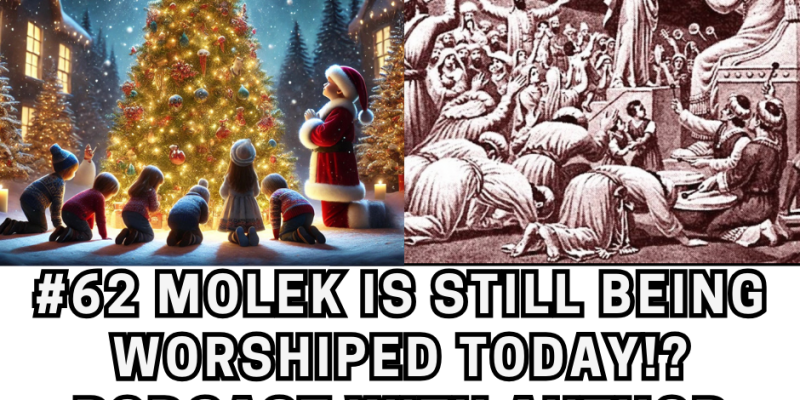
Podcast: Play in new window | Download ()
Subscribe: Gaana | Email | TuneIn | RSS | More
Indeed Satan has truly deceived the whole world. If you believe this statement to be true, then you must consider how you too, may have been
deceived as well. I pray Yehovah will open your minds to see those truths written here on this website.
Whole article: https://sightedmoon.com/are-you-worshipping-molech/
Duet. 12:1-4, 29-32 (NAB) ” (1)These are the statutes and decrees which you must be careful to observe in the land which the Lord, the God of your fathers, has given you to occupy, as long as you live on its soil. (2)Destroy without fail every place on the high mountains, on the hills, and under every leafy tree where the nations you are to dispossess worship their gods. (3)Tear down their altars, smash their sacred pillars, destroy by fire their sacred poles, and stamp out the remembrance of them in any such place. (4)That is not how you are to worship the Lord your God.”
(29)When the Lord, your God, removes the nations from your way as you advance to dispossess them, be on your guard! Otherwise, once they have been wiped out before you and you have replaced them and are settled in their land, (30)you will be lured into following them. Do not inquire regarding their gods, ˜How did these nations worship their gods? I, too, would do the same .” (31)You shall not thus worship the Lord your God, because they offered to their gods every abomination that the Lord detests, even burning their sons and daughters to their gods.”
Lev. 18:21,(NAB) “You shall not offer any of your offspring to be immolated to Molech, thus profaning the name of the Lord you God.”
In the King James, it says to pass through the fire to Molech.
Lev. 18:1-5,(NAB) ” The Lord said to Moses, (2)”Speak to the Israelites and tell them: I, the Lord am your God. (3) You shall not do as they do in the land of Egypt, where you once lived, nor shall you do as they do in the land of Canaan, where I am bringing you; do not conform to their customs. (4)My decrees you shall carry out and my statutes you shall take care to follow. I, the Lord, am your God. (5)Keep, then, my statutes and decrees, for the man who carries them out will find life through them. I am the Lord you God.
Lev.18:24-30 (NAB) ” Do not defile yourselves by any of these things by which the nations whom I am driving out of your way have defiled themselves. (25) Because their land has become defiled, I am punishing it for its wickedness, by making it vomit out its inhabitants. (26) You, however, whether natives or resident aliens, must keep my statutes and decrees forbidding all such abominations (27) by which the previous inhabitants defiled the land; (28) otherwise the land will vomit you out also for having defiled it, just as it vomited out the nations before you. (29) Everyone who does these abominations shall be cut off from among his people. (30) Heed my charge, then, not to defile yourselves by observing the abominable customs that have been observed before you. I, the Lord , am your God.“
From the Zondervan Bible Dict. Moloch, Molech, Muluk, Malik, Chemosh, Milcom (1 Kings 11:5), Malcam (Zeph 1:5) are all variants of Hebrew words meaning “the reigning one”. A heathen god worshiped especially by the Amorites with gruesome orgies in which little ones were sacrificed. At least in some places, an image of the god was heated and the bodies of the children who had just been slain were placed in the arms.
Note ” the statue was made of bronze or iron with a hollowed out human body and the head of a calf. A fire was heated in the statute till a red glow came from the statute then the child was placed on the outstretched arms as a sacrificial offering.

From Wikipedia http://en.wikipedia.org/wiki/Molech
– Ba’al
Moloch the God Ba’al, the Sacred Bull, was widely worshipped in the ancient Near East and wherever Punic culture extended. Baal Moloch was conceived under the form of a calf or an ox or depicted as a man with the head of a bull.
Hadad, Baal or simply the King identified the god within his cult. The name Moloch is not the name he was known by among his worshippers, but a Hebrew translation. The written form Moloch (in the Septuagint Greek translation of the Old Testament), or Molech (Hebrew), is no different than the word Melech or king, transformed by interposing the vowels of bosheth or ‘shameful thing’.
He is sometimes also called Milcom in the Old Testament (1 Kings 11:5, 1 Kings 11:33, 2 Kings 23:13 and Zephaniah 1:5)Forms and grammar
The Hebrew letters מלך (mlk) usually stands for melek ‘king’ (Proto-Northwest Semitic malku) but when vocalized as mÅlek in Masoretic Hebrew text, they have been traditionally understood as a proper name Μολοχ (molokh) (Proto-Northwest Semitic Mulku) in the corresponding Greek renderings in the Septuagint translation, in Aquila, and in the Greek Targum. The form usually appears in the compound lmlk. The Hebrew preposition l- means ‘to’, but it can often mean ‘for’ or ‘as a(n)’. Accordingly one can translate lmlk as “to Moloch” or “for Moloch” or “as a Moloch”, or “to the Moloch” or “for the Moloch” or “as the Moloch”, whatever a “Moloch” or “the Moloch” might be. We also once find hmlk ‘the Moloch’ standing by itself.
Because there is no difference between mlk ‘king’ and mlk ‘moloch’ in unpointed text, interpreters sometimes suggest molek should be understood in certain places where the Masoretic text is vocalized as melek, and vice versa.
Moloch has been traditionally interpreted as the name of a god, possibly a god titled the king, but purposely misvocalized as Molek instead of Melek using the vowels of Hebrew bosheth ‘shame’.
Moloch appears in the Hebrew of 1 Kings 11.7 (on Solomon’s religious failings):
Then did Solomon build a high place for Chemosh, the abomination of Moab, in the hill that is before Jerusalem, and lmlk, the abomination of the Sons of Ammon.
But in other passages the god of the Ammonites is named Milcom, not Moloch (see 1 Kings 11.33; Zephaniah 1.5). The Septuagint reads Milcom in 1 Kings 11.7 instead of Moloch which suggests a scribal error in the Hebrew. Many English translations accordingly follow the non-Hebrew versions at this point and render Milcom.
(The form mlkm can also mean ‘their king’ as well as Milcom and therefore one cannot always be sure in some other passages whether the King of Ammon is intended or the god Milcom.) It has also been suggested that the Baâ’al of Tyre, Melqart ‘king of the city’ (who was probably the Baâ’al whose worship was furthered by Ahab and his house) was this supposed god Moloch and that Melqart/Moloch was also Milcom the god of the Ammonites and identical with other gods whose names contain mlk. But nothing particularly suggests these identifications other than mlk in the various names.
But you shall carry Sikkut your king,
and Kiyyun, your images, the star-symbol of your god
which you made for yourself.
The Septuagint renders ‘your king’ as Moloch, perhaps from a scribal error, whence the verse appears in Acts 7.43:
You have lifted up the shrine of Molech
and the star of your god Rephan,
the idols you made to worship.
Accordingly this association of Moloch with these other gods is probably spurious.
All other references to Moloch use mlk only in the context of “passing children through fire lmlk”, whatever is meant by lmlk, whether it means “to Moloch” or means something else. It has traditionally been understood to mean burning children alive to the god Moloch. But some have suggested a rite of purification by fire instead, though perhaps a dangerous one. References to passing through fire without mentioning mlk appear in Deuteronomy 12.31, 18.10–13; 2 Kings 21.6; Ezekiel 20.26,31; 23.37. So the existence of this practice is well documented. For a comparable practice of rendering infants immortal by passing them through the fire, indirectly attested in early Greek myth, see the entries for Thetis and also the myth of Demeter as the nurse of Demophon.
Biblical texts
The pertinent Biblical texts follow in very literal translation. The word here translated literally as ‘seed’ very often means offspring. The forms containing mlk have been left untranslated. The reader may substitute either “to Moloch” or “as a molk”.
Leviticus 18.21
And you shall not let any of your seed pass through Mo’lech, neither shall you profane the name of your God: I am the Lord.
Leviticus 20.25:
Again, you shall say to the Sons of Israel: Whoever he be of the Sons of Israel or of the strangers that sojourn in Israel, that gives any of his seed Mo’lech; he shall surely be put to death: the people of the land shall stone him with stones. And I will set my face against that man and will cut him off from among his people; because he has given of his seed Mo’lech, to defile my sanctuary, and to profane my holy name. And if the people of the land do at all hide their eyes from that man, when he gives of his seed Mo’lech, and do not kill him, then I will set my face against that man, and against his family, and will cut him off, and all that go astray after him, whoring after Mo’lech from among the people.
2 Kings 23.10 (on King Josiah’s reform):
And he defiled the Tophet, which is in the valley of Ben-hinnom, that no man might make his son or his daughter pass through the fire Mo’lech.
Jeremiah 32.35:
And they built the high places of the Ba’al, which are in the valley of Ben-hinnom, to cause their sons and their daughters to pass through the fire Mo’lech; which I did not command them, nor did it come into my mind that they should do this abomination, to cause Judah to sin.
Moloch has also been referred to simply as a rebel angel.
Traditional accounts and theories
The 12th-century rabbi Rashi, commenting on Jeremiah 7.31 stated:
Tophet is Moloch, which was made of brass; and they heated him from his lower parts; and his hands being stretched out, and made hot, they put the child between his hands, and it was burnt; when it vehemently cried out; but the priests beat a drum, that the father might not hear the voice of his son, and his heart might not be moved.
A different rabbinical tradition says that the idol was hollow and was divided into seven compartments, in one of which they put flour, in the second turtle-doves, in the third a ewe, in the fourth a ram, in the fifth a calf, in the sixth an ox, and in the seventh a child, which were all burnt together by heating the statue inside.
Later commentators have compared these accounts with similar ones from Greek and Latin sources speaking of the offering of children by fire as sacrifices in the Punic city of Carthage, which was a Phoenician colony. Cleitarchus, Diodorus Siculus and Plutarch all mention burning of children as an offering to Cronus or Saturn, that is to Ba’al Hammon, the chief god of Carthage. Issues and practices relating to Moloch and child sacrifice may also have been overemphasized for effect. After the Romans finally defeated Carthage and totally destroyed the city, they engaged in post-war propaganda to make their archenemies seem cruel and less civilized.
Paul G. Mosca in his thesis (described below) translates Cleitarchus’ paraphrase of a scholia to Plato’s Republic as:
There stands in their midst a bronze statue of Kronos, its hands extended over a bronze brazier, the flames of which engulf the child. When the flames fall upon the body, the limbs contract and the open mouth seems almost to be laughing until the contracted body slips quietly into the brazier. Thus it is that the ‘grin’ is known as ‘sardonic laughter,’ since they die laughing.
Diodorus Siculus (20.14) wrote:
There was in their city a bronze image of Cronus extending its hands, palms up and sloping toward the ground, so that each of the children when placed thereon rolled down and fell into a sort of gaping pit filled with fire.
Diodorus also relates relatives were forbidden to weep and that when Agathocles defeated Carthage, the Carthaginian nobles believed they had displeased the gods by substituting low-born children for their own children. They attempted to make amends by sacrificing 200 children at once, children of the best families, and in their enthusiasm actually sacrificed 300 children.
Plutarch wrote in De Superstitiones 171:
… the whole area before the statue was filled with a loud noise of flutes and drums so that the cries of wailing should not reach the ears of the people.
Lev.20:1-5 (NAB) The Lord said to Moses, (2) “Tell the Israelites : Anyone, whether an Israelite or an alien residing in Israel, who gives any of his offspring too Molech shall be put to death. Let his fellow citizens stone him. (3) I myself will turn against such a man and cut him off from the body of his people; for in giving his offspring to Molech, he has defiled my sanctuary and profaned my holy name. (4) Even if his fellow citizens connive at such a man’s crime of giving his offspring to Molech, and fail to put him to death, (5) I myself will set my face against that man and his family and will cut off from their people both him and all who join him in this wanton worship of Molech.”
Yahweh didn’t want Israel to begin to look on Him like Molech.
As incredible as it may sound in Psalm 106:34-28 it tells us that Israel did get involved in this worship.
(34)They did not exterminate the peoples, as the Lord had commanded them, (35)But mingled with the nations and learned their works. (36)They served their idols, which became a snare for them. (37)They sacrificed their sons and their daughters to demons, (38)And they shed innocent blood, the blood of their sons and their daughters, whom they sacrificed to the idols of Canaan, desecrating the land with bloodshed;
The Catholic Encyclopedia says the primitive title of this god was very probably Melech, “King”, the consonants came to be combined through derision with the vowels of the word BOSETH, “shame”. Or king of shame
Speaking of the Phoenicians the catholic encyclopedia says
“They deified the sun and the moon which they considered the great forces that create and destroy, and called them Baal, and Astaroth. Each city had its divine pair: at Sidon it was Baal Sidon (the sun) and Astarte (the moon); at Gebel , Baal Tummuz and Baaleth; at Carthage, Baal Hamon and Tanith. But the same god changed his name accordingly as he was conceived creator or destroyer; thus Baal as destroyer was worshipped at Cartage under the name of Moloch. As creators they were honored with orgies and tumultuous feast; as destroyers by human victims. Baal Moloch was figured at Carthage as a bronze colossus with arms extended and lowered. To appease him children were laid in his arms , and fell at once into a pit of fire. “
In Ezek 23:39 (NAB) Yahweh says
” On the very day they slew their children for their idols they entered my sanctuary to desecrate it.” The Israelite’s had mixed Yahweh’s worship with the worship of Moloch just as he had said not to.
In Jeremiah 19:1-15 (NIV)
Thus said the Lord, “Go, buy a potter’s earthen flask, and take some of the elders of the people and some of the senior priest, (2) and go out to the valley of the son of Hinnom at the entry of the Potsherd Gate , and proclaim there the words that I tell you. (3) You shall say, “Hear the word of the Lord, O kings of Judah and inhabitants of Jerusalem. Thus says the Lord of hosts, the God of Israel, Behold, I am bringing such evil upon this place that the ears of every one who hears of it will tingle. (4) Because the people have forsaken me, and have profaned this place by burning incense in it to other gods whom neither they nor their fathers nor the kings of Judah have known; and because they have filled this place with the blood of innocents, (5) and have built the high places of Ba’al to burn their sons in the fire as burnt offerings to Ba’al, which I did not command or decree, nor did it come into my mind; (6) therefore , behold, days are coming, says the Lord , when this place shall no more be called Topheth, or the valley of the son of Hinnon, but the valley Slaughter. (7) And in this place I will make void the plans of Judah and Jerusalem, and will cause their people to fall by the sword before their enemies, and by the hand of those who seek their life. I will give their dead bodies for food to the birds of the air and to the beasts of the earth. (8) And I will make this city a horror, a thing to be hissed at ; every one who passes by it will be horrified and will hiss because of all its disasters. (9) And I will make them eat the flesh of their sons and their daughters, and every one shall eat the flesh of his neighbor in the siege and in the distress, with which their enemies and those who seek their life afflict them.”
(10) Then you shall break the flask in the sight of the men who go with you, (11) and you shall say to them, “Thus says the Lord of hosts: So will I break this people and this city, as one breaks a potters vessel, so that it can never be mended. Men shall bury in Topheth because there will be no place else to bury. (12) Thus will I do to this place, says the Lord, and to its inhabitants, making this city like Topheth. (13) The houses of Jerusalem and the houses of the kings of Judah – all the house upon whose roofs incense has been burned to all the host of heaven, and drink offerings have been pored out to other gods – shall be defiled like the place of Topheth.”
(14)Then Jeremiah came from Topheth, where the Lord had sent him to prophesy , and he stood in the court of the Lord’s house, and said to all the people: (15) “Thus says the Lord of hosts, the God of Israel, Behold, I am bringing upon this city and upon all its towns all the evil that I have pronounced against it, because they have stiffened their neck, refusing to hear my words.”
Topheth in Strongs concordance is #8612 taken from #8611 to mean a smiting or contempt. Tophteh #8613 is from #8612 meaning a place of cremation. And #8611 is taken from #8608 taphaph meaning to play on the drum the tambourine; play with timbrels.
Note it says that the drums were played to drown out the screams of the children who were being cremated alive.
From the Catholic encyclopedia, Topheth was the place where Judas Iscariot hung himself and his body fell and burst open on the rocks below. The field of blood (Haceldama).
From the Chamber Encyclopedia under Molech, it is clear that in Palestine and Syria from at least the 18th century BC infants about 8 days old were sacrificed and buried in womb shape jars, possibly in connection with fertility rites. In the king cult, the king was regarded as the son embodiment of god & the Hebrew phrase “to the molech” may have meant for the sake of the life of the king. Remember we said earlier Melek = king of the netherworld.
Jeremiah (NIV)7: 30-31For the sons of Judah have done evil in my sight , says the Lord; they have set their abomination in the house which is called by my name, to defile it (31) And they have built the high place of Topheth which is in the valley of the son of Hinnom, to burn their sons and their daughters in the fire, which I did not command nor did it come into my mind.
Jeremiah (NIV) 8:1-2 At that time, say the Lord, the bones of the kings of Judah, the bones of its princes, the bones of the priest, the bones of the prophets and the bones of the inhabitants of Jerusalem shall be brought out of their tombs; (2) and they shall be spread before the sun and the moon and all the host of heaven, which they have loved and served, which they have gone after, and which they have sought and worshipped; and they shall not be gathered or buried; they shall be as dung on the surface of the ground.
Note: They are worshiping the sun god Ba’al Moloch and the moon god Astarte. That’s why Yahweh spreads them out before their god as dung.
Jeremiah (NIV)32:28,30-35 “Behold I am giving this city into the hands of the Chaldeans and into the hand of Nebuchadrezzar King of Babylon and he shall take it. (30) For the sons of Israel and the sons of Judah have done nothing but evil in my sight from their youth; the sons of Israel have done nothing but provoke me to anger by the works of their hands, says the Lord. (31) This city has aroused my anger and wrath, from the day it was built to this day, so that I will remove it from my sight (32) because of all the evil the sons of Israel and the sons of Judah which they did to provoke me to anger – their kings and their princes, their priest and their prophets, the men of Judah, and the inhabitants of Jerusalem. (33) They have turned to me their back and not their face; and though I have taught them persistently they have not listened to receive instruction. (34) They have set up their abominations in the house which is called by my name, to defile it. (35) They built the high places of Ba’al in the valley of the son of Hinnom, to offer up their sons and daughters to Molech, though I did not command them , nor did it enter into my mind, that they should do this abomination, to cause Judah to sin.
So in the early 600’s BC in Jeremiah’s time, this was the official religion and it included child sacrifices.!!
But even in King Solomon’s day, it was going on.
1 Kings 11:1-13 (NKJV) But King Solomon loved many foreign woman, as well as the daughter of Pharaoh: women of the Moabites, Ammonites, Edomites, Sidonians, and Hittites- (2) from the nations of whom the Lord had said to the children of Israel, “You shall not intermarry with them , nor they with you. Surely they will turn away your hearts after their gods.” Solomon clung to these in love. (3) And he had seven hundred wives, princesses, and three hundred concubines; and his wives turned away his heart.
(4)For it was so, when Solomon was old, that his wives turned his heart after other gods; and his heart was not loyal to the Lord his God, as was the heart of his father David. (5) For Solomon went after Ashtoreth the goddess of the Sidonians, and after Milcom the abomination of the Ammonites. (6) Solomon did evil in the sight of the Lord, and did not fully follow the Lord, as did his father David.
[Notes He partially followed Yahweh and partially followed other gods. Mixing Yahweh’s religion with foreign gods.]
Then Solomon built a high place for Chemosh the abomination of Moab, on the hill that is east of Jerusalem, (Mount of Olives and Mount of Corruption, 2 Kings 23:13) and for Molech the abomination of the people of Ammon. (8) And he did likewise for all his foreign wives, who burned incense and sacrificed to their gods.
So the Lord became angry with Solomon, because his heart had turned from the Lord God of Israel, who had appeared to him twice, (10) and had commanded him concerning this thing, that he should not go after other gods; but he did not keep what the Lord had commanded. (11) therefore the Lord said to Solomon, “Because you have done this, and have not kept My covenant and My statutes, which I have commanded you, I will surely tear the kingdom away from you and give it to your servant. (12) Nevertheless I will not do it in your days for the sake of your father David; I will tear it out of the hand of your son. (13) However I will not tear away the whole kingdom; I will give one tribe to your son for the sake of my servant David, and for the sake of Jerusalem which I have chosen.
Note. Solomon’s weakness greatly encouraged this worship, and for this reason, Yahweh stripped the dynasty from him. Because he and his wives were sacrificing children.
2 Kings 16:1-4 (NKJV) In the seventeenth year of Pekah the son of Remaliah, Ahaz, the son of Jothan, king of Judah began to reign. (2) Ahaz was twenty years old when he became king, and he reigned sixteen years in Jerusalem; and he did not do what was right in the sight of the Lord his God, as his father David had done. (3) But he walked in the way of the kings of Israel; indeed he made his son pass through the fire, according to the abominations of the nations whom the Lord had cast out from before the children of Israel. (4) And he sacrificed and burned incense on the high places, on the hills and under every green tree.
2 Chronicles 28:3 (NKJV) He burned incense in the valley of the son of Hinnom, and burned his children in the fire, according to the abominations of the nations whom the Lord had cast out before the children of Israel.
2 Chronicles 33:1-9 (NKJV) Manassah was twelve years old when he became king, and he reigned fifty five years in Jerusalem. (2) But he did evil in the sight of the Lord , according to the abominations of the nations whom the Lord had cast out before the children of Israel. (3) For he rebuilt the high places which Hezekiah his father had broken down; [My notes Hezekiah was Ahaz’s son.] he raised up altars for the Ba’als, and made wooden images; and he worshiped all the host of heaven and served them. [Chambers Encyclopedia melech was often used as divine name for heavenly king.] (4) He also built altars in the house of the Lord of which the Lord had said “In Jerusalem shall My name be forever”. (5) And he built altars for all the host of heaven in the two courts of the house of the Lord. (6) Also he caused his sons to pass through the fire in the Valley of the son of Hinnom; he practiced soothsaying, used witchcraft and sorcery. He did much evil in the sight of the Lord to provoke Him to anger. (7) he even set a carved image , the idol which he had made , in the house of God,..(9) So Manassah seduced Judah and the inhabitants of Jerusalem to do more evil than the nations whom the Lord had destroyed before the children of Israel.
[Read on to see how Manassah repented.]
In 2 Kings 23: 1-28 we read how Josiah destroyed all the altars and poles and shrines. It is a good read but I want to point out the following scriptures. (5)Then he removed the idolatrous priests whom the kings of Judah had ordained to burn incense on the high places in the cities of Judah and in the places all around Jerusalem and those who burned incense to Ba’al , to the sun, to the moon , to the constellations, and to the host of heaven. (10) And he defiled Topheth, which is in the Valley of the son of Hinnom, that no man might make his son or daughter pass through the fire to Molech. (11) then he removed the horses that the kings of Judah had dedicated to the sun, at the entrance to the house of the Lord, and he burned the chariots of the sun with fire.
And again in the book of Acts, Stephen just before he is martyred says in
Acts 7:42-43 Then God turned and gave them over to worship the whole host of heaven, as it is written in the prophets; (43) You also took up the tabernacle of Moloch, And the star of your god Remphan, images which you made to worship;.. Stephen is quoting Amos 5:25-27 where he says in verse (26) You also carried Sikkuth (Moloch) your king and Chiun your idols, the star of your idols which you made for yourselves.
It says in Amos 5:21 I hate, I despise your feast days, and I do not savor your sacred assemblies.
Why does God hate our feast days? We know how much he hates Molech and Astarte , but we don’t worship them. Or Do we??? DO YOU?
In Ezekiel 20: 18-21
“But I said to the children in the wilderness, “Do not walk in the statutes of your fathers, nor observe their judgements, nor defile yourselves with their idols. (19) I am the Lord your God: Walk in My statutes, keep My judgements, and do them; (20) HALLOW My Sabbaths, and they will be a sign between Me and you, that you may know that I am the Lord your God. (26) and I pronounced them unclean because of their ritual gifts, in that they caused all their firstborn to pass through the fire, that I might make them desolate and that they might know that I am the Lord. (31) “For when you offer your gifts and make your sons pass through the fire, you defile yourselves with all your idols, even to this day.
That day was in Ezekiel’s day, but as Revelation 2:14 points out it was still going on in the 90’s AD.
(14) But I have a few things against you, because you have there those who hold the doctrine of Balaam, who taught Balaak to put a stumbling block before the children of Israel, to eat things sacrificed to idols, and to commit sexual immorality. (15) Thus you also have those who hold the doctrine of the Nicolaitans which thing I hate,
The Catholic Encyclopedia on Nicolatians reveals very little other than to say, ” based on the identical meaning of the names to the Bileamites or Balaamites (Rev 2:14) who are mentioned just before them as professing the same doctrines.
The Catholic Encyclopedia under Moloch it says,” The offerings by fire, the probable identity of Moloch with Baal, and the fact that in Assyria and Babylonia Malik, and at Palmyra Malach-bel, were sun-gods, have suggested to many that Moloch was a fire or sun-god.
The following article traces Moloch back to Nimrod and also shows how he was connected to the Roman Mithra and Saturnalia.
Bible Prophecy Research Title: Moloch Submitted by: owner-bpr@philogos.org (Ronni)Date: August, 1999URL: http://philogos.org/bpr/files/m009.htm Moloch
(Amos 5:25-26) “Have ye offered unto me sacrifices and offerings in the wilderness forty years, O house of Israel? {26} But ye have borne the tabernacle of your Moloch and Chiun your images, the star of your god, which ye made to yourselves.” (Acts 7:43) “Yea, ye took up the tabernacle of Moloch, and the star of your god Remphan, figures which ye made to worship them: and I will carry you away beyond Babylon.”
Moloch (or Molech) Moloch was the Old Testament deity of the Ammonites. The Israelites later fell into idolatrous worship of this pagan god:
(Judg 10:6) “And the children of Israel did evil again in the sight of the LORD, and served Baalim, and Ashtaroth, and the gods of Syria, and the gods of Zidon, and the gods of Moab, and the gods of the children of Ammon, and the gods of the Philistines, and forsook the LORD, and served not him.”
(1 Ki 11:5-6) “For Solomon went after Ashtoreth the goddess of the Zidonians, and after Milcom [Moloch] the abomination of the Ammonites. {6} And Solomon did evil in the sight of the LORD, and went not fully after the LORD, as did David his father.” Moloch was “honored by the sacrifice of children, in which they were caused to pass through or into the fire.
Palestinian excavations have uncovered evidences of infant skeletons in burial places around heathen shrines. Ammonites revered Molech as a protecting father…No form of ancient Semitic idolatry was more abhorrent than Molech worship.”[1] From Milton’s Paradise Lost: “First Moloch, horrid king, besmeared with blood Of human sacrifice, and parents’ tears, Though, for the noise of drums and timbrels loud,Their children’s cries unheard, that passed through fire to his grim idol.” Exactly how human sacrifices were made is uncertain, but some rabbinic writers suggest that Moloch was worshipped in the form of a hollow brass statue in the shape of a human but with a head of an ox. The children were placed inside the statue which was then heated from below. The cries of the victims were drowned out by the beating of drums. One ancient description of Moloch reads: “Unlike the houses of the other idols, that of Moloch was set outside the city. It was gigantic in form and had the head of what appeared to be an ox, the hands stretched out as if to receive something, the body was hollow inside. Before the idol, there were seven temples, the first six of which were employed for the sacrifice of various fowl and animals, the seventh reserved for a human sacrifice.” [2] Diodorus has a slightly different description of the ritualistic sacrifices offered to Moloch: “First, the devotee would kiss the image of Moloch. He would then make a fire under the idol, which would quickly cause the hands of the statue to become red-hot. A victim would then be placed in the hands to suffer an agonizing death. His cries would be muffed by the drums. While this was taking place, the prophets would dance around an altar, with violent gesticulations, and, having excited themselves to a pitch of frenzy by it, as well as by their fearful vociferations they began to cut their bodies with knives and lancets. In this unnatural state they began to prophesy, or rather rave, as if possessed by some invisible power.”
[3] “The etymology of the term ‘Molech’ is interesting. Scholars suggest that it is a deliberate misvocalization of the Hebrew word for king or for the related participle (molek), ‘ruler.’ They propose that the consonants for the Hebrew word for king (mlk) were combined with the vowels from the word for shame (boshet) [king of shame]. Thus, this title was a divine epithet expressing contempt for the pagan god.”
[4] This has lead many to believe that the word “Moloch” is not a proper name at all. An article by Moshe Weinfeld in the Encyclopedia Judaica has an opposing viewpoint on the ritualistic worship and identity of Moloch: “The testimonies of the Pentateuch, which seem to be the most ancient and therefore the most reliable ones, should be divided, according to the formulation of the law, into two groups: the laws of the Holiness Code which speak about giving or passing children (lit. seed) to Moloch (Lev. 18:21; 20:2, 3, 4) and the law in Deuteronomy which speaks of ‘passing [one’s] son or daughter through fire’ (18:10). The author of the Book of Kings, who was influenced ideologically and stylistically by Deuteronomy, speaks about ‘passing [one’s] son and daughter through fire’ (II Kings 16:3; 17:17; 21:6). II Kings 23:10 speaks about ‘passing [one’s] son or daughter through fire to Moloch,’ which actually constitutes a conflation of the formula in Leviticus with that of Deuteronomy. In all these sources there is no mention of ‘burning’ or ‘sacrificing’ (slaughtering) children to Moloch. These latter terms are found, on the other hand, in the prophetic sources: Jeremiah 7:31; 19:5; Ezekiel 16:21; 20:31; 23:37, 39; and one may add here Isaiah 57:5; and Psalms 106:37-38. The difference in the presentation of the Moloch worship in the legal-historical and in the prophetic sources is significant. A legislator has to be precise in his formulation and therefore his description is more trustworthy than that of the prophet or preacher who tends to exaggerate. At any rate, the fact that the legal-historical, in contrast to the prophetic poetic, sources do not mention real burning should serve as a warning against a hasty identification of Moloch with human sacrifice.
Sign up for our weekly Free Newsletter https://sightedmoon.com/newsletter-lp/
We are also giving away The Stones Cry Out PDF for FREE at this link https://sightedmoon.com/the-stones-cry-out-lp/
You can also order the following books to learn more about where we are in these last days according to the Jubilee Cycle.
It Was A Riddle Not A Command (https://sightedmoon.com/riddle-lp)
The 2300 Days of Hell (https://sightedmoon.com/2300-days-lp)
Remembering the Sabbatical Year of 2016 https://sightedmoon.com/2016-sabbatical-year-co/
The Sabbatical and Jubilee Charts https://sightedmoon.com/sabbatical-chart-lp/
The Restoration of All Things https://sightedmoon.com/restoration-abomination-co/
The Abomination That Makes Desolate https://sightedmoon.com/restoration-abomination-co/
The 10 Days of Awe https://sightedmoon.com/10-days-of-awe-co/